Be precise about your patch.
Bakers Arms is listed with E10. These are representative postcode districts, not exact boundaries. A complete job address and your starting point matter more than a district label.

At Bakers Arms, a useful application makes your own offer clear. Set out the household services you know, the working period you can maintain and the address details you need before deciding whether a visit is practical.
Each job is agreed around its address, tasks, hours and your suitability.
 Bakers Arms · E10
Moving area names stop while hovered or focused. Press Enter or Space, or tap the moving area, to keep them still after leaving. Activate again to allow movement. Browse the directory for the complete list.
Choose the work you can deliver reliably, with clear travel limits, availability and skills.
Bakers Arms is listed with E10. These are representative postcode districts, not exact boundaries. A complete job address and your starting point matter more than a district label.
Share the days and hours you can reliably work, allowing time between visits. Early starts, evening finishes and any travel limits need to be clear before a job is agreed.
Tell us which cleaning tasks you can confidently deliver. Ironing, laundry and detailed cleaning use agreed time; specialist work needs the appropriate skills and equipment.
 Bakers Arms · E10
Walthamstow · Leyton · Leytonstone · Chingford. Compare your preferred areas and check the complete address and journey before agreeing any work.
Waltham Forest’s Bakers Arms appraisal identifies the junction of Hoe Street, High Road Leyton and Lea Bridge Road as part of the local context. Historic England separately records the Bakers Almshouses on Lea Bridge Road, Leyton E10. These documented references help distinguish the locality when discussing a working preference. Their presence here does not establish a cleaning opening at the listed buildings or a relationship with the agency.
A junction may help explain the general setting, but a real offer still needs its full private address. State the boundary you can reasonably consider and leave room to assess the destination from your actual starting point. Do not infer a guaranteed journey duration from the public references or treat the E10 label as unrestricted availability. This gives the agency a preference with practical meaning and gives you an opportunity to understand the actual commitment before accepting a household visit.
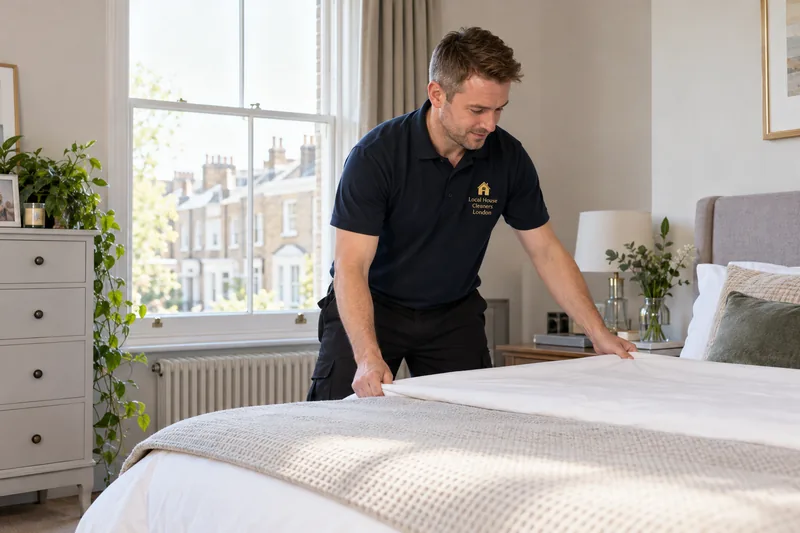 Bakers Arms · E10
Describe the household work you know through actions rather than adjectives alone. Explain how you followed instructions, checked a result or clarified an uncertainty. An anonymous example gives the agency a way to discuss your judgement without receiving a former customer’s private details. There is no need to embellish it with specialist claims or an unrealistic promise that every task is easy.
Separate ordinary accessible cleaning from services that require different knowledge. Suitable floor care, selected kitchen duties and bathroom work can be identified clearly. Restoration, work at height or specialist treatment should not be implied by a general description of experience. If ironing or laundry support is offered, explain the relevant skill in its own right. A precise introduction supports a more useful assessment because it tells the agency what can genuinely be discussed, rather than making every possible future request appear automatically covered.
Before agreeing to a visit, clarify which outcomes the household values first. Identify the included kitchen surfaces, bathroom fixtures and other accessible areas. Keep internal appliance cleaning explicit where requested, rather than relying on the word kitchen to carry an unstated extra service. Establish exclusions too, including items that should remain untouched.
The allowance should be considered against the actual request and condition. If a material difference changes the work required, raise its effect on the priorities. Explain the issue in terms of the appointment rather than making judgements about the household. A clear decision can revise scope or lead to consideration of an appropriate extension. Without that conversation, added work may quietly displace the service the customer thought it was purchasing. The point of a workable brief is to connect the accepted time with results everyone can understand.
A listed public building provides a local reference, not a specification for the home you may be offered. Do not infer that a property has a particular finish or needs a specialist method because it is associated with the same district. The actual surface, its care information and the household’s instructions should guide your approach. Ask before using a treatment where the material or product is uncertain.
This boundary can be part of a strong experience example. Describing how you recognised a limit and sought guidance demonstrates care without claiming a qualification you do not possess. More time does not by itself make a sensitive treatment appropriate. If the request goes beyond ordinary work you can carry out competently, identify it for separate assessment. That allows the agency to review the real requirement instead of leaving specialist work hidden inside a broad household-cleaning label.
 Bakers Arms · E10
Confirm what equipment and products will be present for the agreed tasks and what you would need to bring. Consider the journey with any accepted kit. A general assurance about cleaning supplies may not answer whether an essential tool is usable or a product suits the specified surface. Identify a material uncertainty early enough for a practical decision.
If a problem is discovered during the appointment, connect it to the result affected. Other agreed work may remain possible, but a change to the service should be understood rather than silently substituted. Do not presume that a shopping trip, borrowing arrangement or purchase belongs within the original offer. Clear equipment arrangements can protect the working allowance for actual cleaning. They also give the household and agency a concrete issue to resolve, rather than discovering at completion that an important priority could not be performed as expected.
Ironing, laundry support and linen changes use part of the same appointment as cleaning. Name the requested stages and understand what completion means for each. A laundry cycle may continue beyond departure, requiring a handover rather than automatically approved overtime. Ironing needs suitable equipment and garment-care information; bed changes need the included beds and linen arrangement understood.
The starting gross rate is £15 per cleaner-hour. Assess a real offer’s duties, allowance and applicable terms alongside that amount. Give a dependable arrival and a latest finish that leaves room for the agreed departure procedure and your next commitment. An additional request needs the appropriate decision and must be practical within your availability. A defined finish is valuable information, not something that disappears because the household would find another service helpful or because more tasks remain.
Provide accurate contact details, relevant skills and working-language information when applying. The website’s reading language is a different setting. Agency approval and required verification remain necessary before allocation; submitting an application does not confirm a vacancy or guarantee earnings. Sensitive identity evidence should go through the designated checking process rather than being placed in ordinary experience notes.
For an agreed visit, establish the private contact route for entry problems or a decision about an instruction. Use the appointment reference to keep the conversation connected to the correct work. At the end, record actual time and explain completed priorities, approved changes and outstanding items. If photographs are permitted, frame the relevant result without private papers or security details. Follow the leaving arrangement as well. That factual close makes the service easier for the household to understand and gives the agency specific information for resolving a question fairly.
The council’s appraisal discusses the junction of Hoe Street, High Road Leyton and Lea Bridge Road. Historic England also records the Bakers Almshouses on Lea Bridge Road, Leyton E10.
No. The listing is used for public local context. A household appointment would need its own offer and instructions; no institutional customer or specialist contract is implied.
A general cleaning label can conceal different expectations about equipment, methods and time. Confirm the actual result so you can assess the offer and the household can understand what was accepted.
Use the complete household address to resolve the actual destination and entry arrangement. A junction can make the preference recognisable without identifying which property, entrance or working period a future offer involves.
Keep your details together with a private cleaner account.
Complete your application with your skills, working areas and dependable availability.
Complete the secure verification process for identity and relevant work eligibility, followed by agency review before approval for work.
Once approved, consider suitable jobs when there is genuine demand. Work is not guaranteed.
Work is subject to agency approval, agreed terms and customer demand.
Cleaner approval includes a review of identity, relevant work eligibility, experience and practical competence. Any work must have an agreed scope, rate and working arrangements before it starts.
Identity checks require a separate secure process. Do not send identity documents through general application fields or job photographs.
Read the application processSee the area before choosing your working patch. Check the actual job address and journey before accepting work.
Area reference only. This map does not mark a company office or confirm service boundaries.
This embedded map is provided by Google, which receives connection information and may use cookies. Google privacy information.
Explore the opportunity and application steps before choosing your working areas.